
For Patients
Allergy Drops Versus Allergy Shots
Allergy drops or allergy shots? Both treat the cause of allergy. This side-by-side comparison helps you and your provider decide which is the better fit for you.
Drops or shots
The only way to change allergic disease is through immunotherapy, which helps build the body’s tolerance to allergens.
Both sublingual immunotherapy (allergy drops) and subcutaneous immunotherapy (allergy shots) slowly introduce the body to offending allergens, building tolerance over time. Both are effective and generally safe; they fit different patients. The question is not which one wins, but which is the better fit for you.
Allergy drops are the better fit for patients who value convenience and at-home dosing with fewer office visits and fewer systemic reactions. Allergy shots are the better fit for patients who prefer to see their physician in person and whose insurance covers in-office immunotherapy with a manageable deductible. Both are valid choices, and your provider will help you decide.
A small number of sublingual immunotherapy (SLIT) tablets are FDA-approved for specific allergens. Personalized allergy drops are compounded by a pharmacy for each patient and prescribed off-label — a long-standing, legitimate practice with decades of use, and SLIT is a first-line prescription approach in much of Europe. Compounded allergy drops are not FDA-approved, but they are created using FDA-approved allergenic extracts, the same as in allergy shots. Off-label does not mean unsafe or experimental.
Updated · Allergychoices
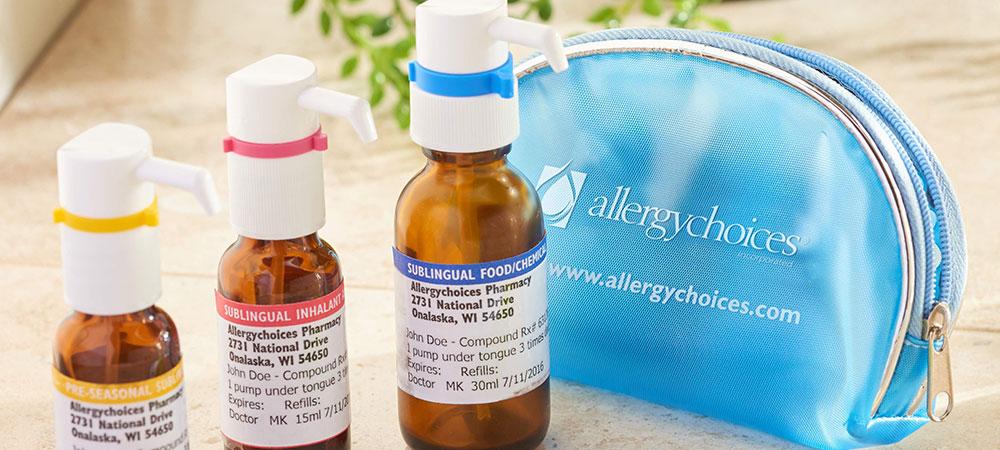
Side by side
Allergy drops compared with allergy shots
Who can use this treatment?
- ALLERGY DROPS
- Patients of all ages, including infants and young children. Many patients with allergic asthma may be candidates; your clinician confirms this.
- ALLERGY SHOTS
- Generally started at age 5 and up. Uncontrolled asthma must be brought under control first; your clinician decides when shots are appropriate.
What can be treated?
- ALLERGY DROPS
- Environmental allergies and food allergies. Food drops are held under the tongue; the dose works through the sublingual tissue and is not eaten.
- ALLERGY SHOTS
- Environmental allergies.
What are the possible side effects?
- ALLERGY DROPS
- Mild itching in the mouth or throat is common early on and usually fades. Systemic reactions are uncommon; as with any immunotherapy a small risk remains, which is why drops are prescribed and monitored by a clinician.
- ALLERGY SHOTS
- Swelling or itching at the injection site is common. Systemic reactions, including rarely anaphylaxis, can occur, which is why shots are given in the office with an observation period and epinephrine on hand.
What is the time commitment?
- ALLERGY DROPS
- 3 metered doses per day from your home, with 2-4 appointments per year for 3-5 years*.
- ALLERGY SHOTS
- In-office injection(s) 1-2 times per week to start and then 1-2 times per month for 3-5 years*.
What is the cost?
- ALLERGY DROPS
- ~$50/month**
- ALLERGY SHOTS
- Often billed to insurance as an in-office procedure; your share depends on your deductible and co-pay, and claims are sometimes only partly covered.**
*treatment time varies based on severity and patient adherence
**Insurance handling varies by plan. Ask your provider for a quote.
What to expect from either option. Many patients notice improvement within the first months or the first allergy season. A full course typically takes 3–5 years, and the benefit can persist for years after treatment ends. Immunotherapy retrains the immune system toward tolerance; it is not a cure, and staying on treatment strongly affects the result.
Sources
Next step
Are allergy drops right for you?
Allergy drops help your body learn to tolerate what's causing your allergic reactions. They are an option for people of all ages.
Learn moreWhat are Allergies Really Costing You?
Allergy drop cost, paid out of pocket, may cost less than allergy prescriptions & treatment covered by insurance! See for yourself with our cost calculator.
Learn moreAllergy Drop Safety and Effectiveness
The La Crosse Method™ Protocol has never had a systemic, anaphylactic or near-fatal reaction reported from sublingual immunotherapy (SLIT) treatment.
Learn more
Find a provider
Want to find a provider near you who offers custom sublingual immunotherapy?
Prefer to talk it through first? Call (866) 793-1680.